
Picking the wrong sales funnel is one of the most expensive mistakes you can make online.
Not because of the money (although that hurts too). Because of the TIME. Three weeks building. Two weeks of tweaking. Another week, wondering why nobody’s buying. That’s almost two months gone before you realize the funnel itself was the problem, not your offer.
This article outlines 18 types of sales funnels organized into three categories:
- Generate leads
- Sell products or services
- Run events.
Each one comes with what it does, how it’s structured, and exactly WHEN to use it so you don’t waste another month on the wrong setup.
Read to the end, and I’ll point you to a resource with the page-by-page blueprint for every funnel type listed here.
1. Lead Magnet Funnel
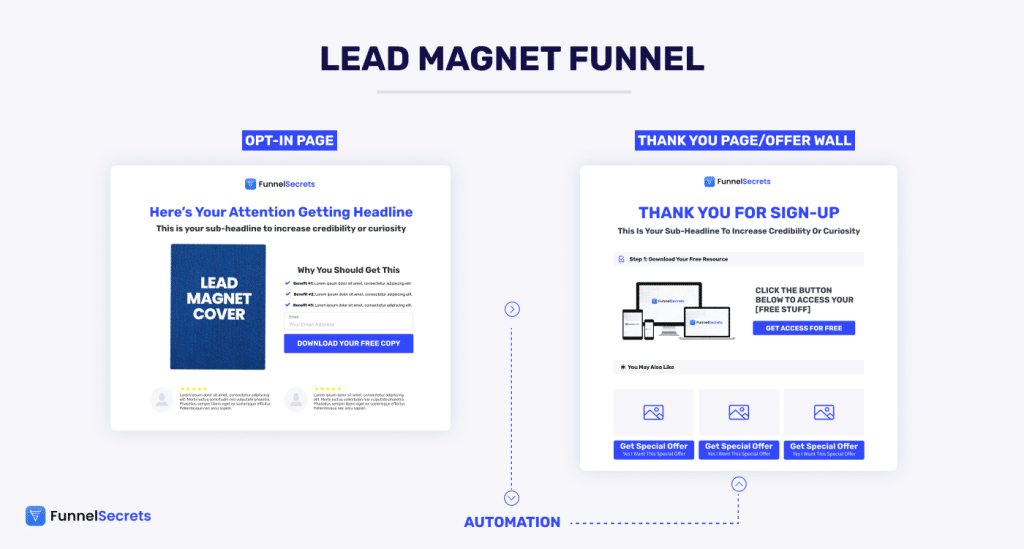
A Lead Magnet funnel offers free and valuable content in exchange for an email address. The free thing is called a “lead magnet” because it attracts (magnets) potential customers (leads) toward your business.
Lead Magnet funnel has 2 Steps:
- Opt-in form: Present the free offer and collect the email
- Thank You page: Confirmation and next step (and optionally, a low-cost offer, more on that in #6)
What makes a lead magnet GOOD?
Three things. It solves ONE specific problem. It’s quick to consume (under 10 minutes). And it directly relates to what you sell.
Common lead magnet formats that work:
- Checklists (e.g., “The 15-Point Facebook Ad Audit Checklist”)
- Templates (e.g., “Email Sequence Templates for Course Launches”)
- Swipe files (e.g., “50 Proven Subject Lines That Get 40%+ Open Rates”)
- Mini-courses (e.g., “3-Day Email Marketing Crash Course”)
Use this funnel when you want qualified leads. It pre-qualifies the subscriber based on interest.
Someone who downloads your “15-Point Facebook Ad Audit Checklist” is probably running Facebook ads. That means they’re a good fit for your Facebook ads course. Someone who grabs your “Email Sequence Templates for Course Launches” is probably building a course. That person is pre-qualified for your course creation program.
The lead magnet does the filtering for you before you ever send a sales email.
2. Squeeze Page Funnel
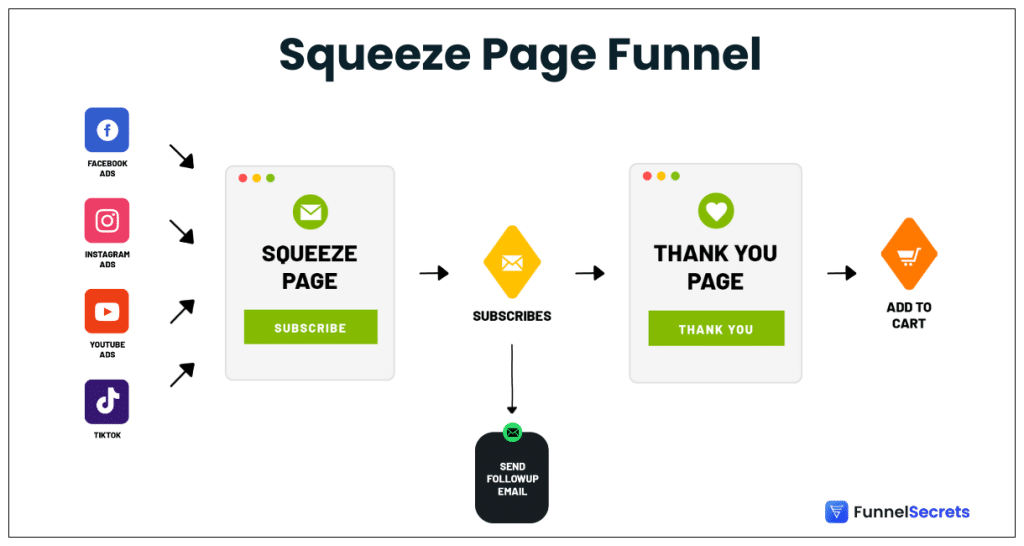
A squeeze page funnel is a type of lead magnet funnel that uses a dedicated squeeze page to collect email addresses.
One page. One job. Get the email.
No navigation bar, no sidebar, no blog links. Just a headline, a value promise, and an opt-in form. The visitor either opts in or leaves. That’s why it’s called a “squeeze” page. You’re squeezing out their contact info by removing every other option on the page.
How is it structured?
- Squeeze Page with a headline, a short value promise, and an opt-in form
- Thank You Page with a confirmation and next step
Use a squeeze page funnel when you want to build your list FAST.
How is it different from a lead magnet funnel?
Lead magnet funnels are the broader category. They cover any method of generating leads with a free offer, including pop-ups on your website, embedded forms in blog posts, and exit-intent overlays.
A squeeze page funnel is more focused. It uses a standalone page with zero distractions as the ONLY conversion mechanism. No other content on the page is competing for attention.
3. Reverse Squeeze Page Funnel
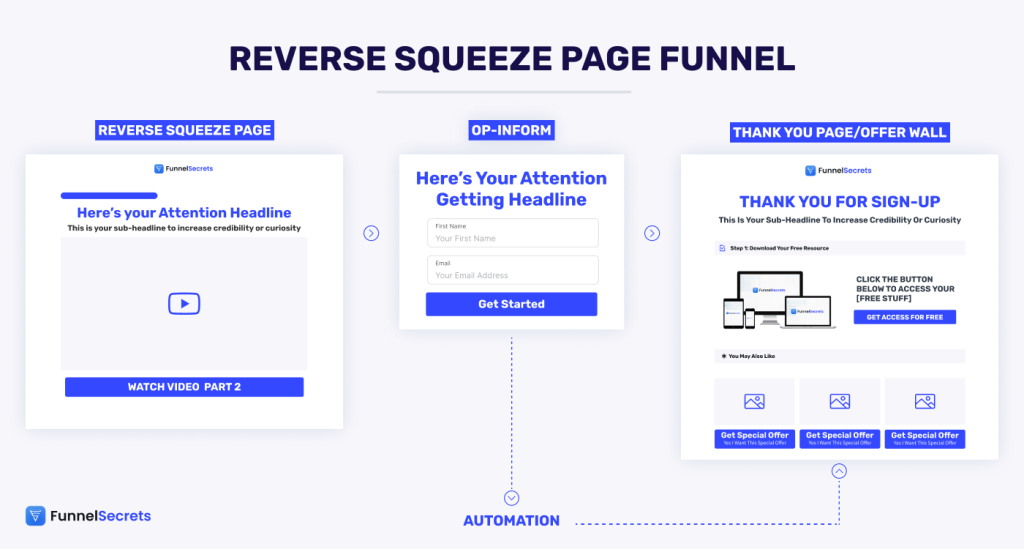
A reverse squeeze page funnel flips the script. Instead of asking for the email FIRST, you give value FIRST (usually a video), and THEN ask for the email.
So why give away value BEFORE asking for the email?
Because the visitor gets to “taste” your content before committing. They watch. They learn something. And when the opt-in form appears, they’re already warm.
A Reverse Squeeze Page funnel has 3 Steps:
- Video/Content Page: The visitor watches a short, high-value video or reads a piece of content. No gate. No form. They consume freely.
- Opt-in Form (appears after the content): The visitor receives value first. Then, they click the CTA button below the video, and a pop-up with an opt-in form appears. The ask feels earned because they already got something useful.
- Thank You Page: Confirms the opt-in and delivers the promised next step (a full guide, a bonus video, or a deeper resource).
This funnel type works when your audience is cold traffic, meaning they don’t know you yet. Coaches, educators, and info-product sellers see strong results because their product IS their knowledge.
A marketing consultant posts a 5-minute video teaching one Facebook Ads hack. After the video, there’s a form: “Want the full 10-hack playbook? Drop your email.”
Pro tip: reverse squeeze page funnels convert well on social media traffic. People scrolling Instagram or YouTube are already in content-consumption mode. Give them a reason to keep watching, and the email capture happens naturally.
4. Survey Funnel
A survey funnel starts with a quiz or survey before showing the offer. The survey segments your audience so you can present the RIGHT offer — not a generic one.
A Survey funnel has 3 Steps:
- Survey/Quiz Page: The visitor answers 3–7 questions about their situation, goals, or pain points. Each answer feeds into a segmentation logic that determines which offer to show next.
- Results Page (customized offer): Based on the answers, this page presents a personalized recommendation. The visitor sees a result that feels tailored to them.
- Sales Page: The visitor clicks through to a full sales page for the recommended product or service, pre-framed by their quiz results.

Why would someone fill out a survey before buying?
Personalization. When people answer questions about themselves, the recommendation feels tailored. Plus, answering questions creates micro-commitments. Each click moves the visitor closer to saying “yes” to the final offer.
Use it when you sell multiple products or variations, or when your audience has different pain points.
A skincare brand asks 5 questions about skin type, concerns, and routine. Based on the answers, the funnel recommends a specific product bundle. Conversion rates jump because the customer sees a personalized result, not a one-size-fits-all sales page.
Ryan Levesque popularized this funnel type. Survey funnels generate 2–3x higher conversion rates than standard sales pages because personalization makes visitors feel like “someone built this offer just for me.”
5. Bridge Funnel
A bridge funnel connects two related but different ideas for the customer. It pre-frames the thing you want to sell before sending the visitor into a sales page or funnel you don’t control. This makes it a go-to funnel for affiliate marketers and network marketers.
A Bridge funnel has 2 Pages:
- Squeeze Page: The visitor lands here first. You present a hook related to the result they want and collect their email. This turns paid or organic traffic into leads you own.
- Bridge Page: After opting in, the visitor sees your page. You connect the dots between what brought them in and the product you’re recommending. A short video works best here. You explain your personal experience, how the product helped you, and why it’s the best path to the result they want.
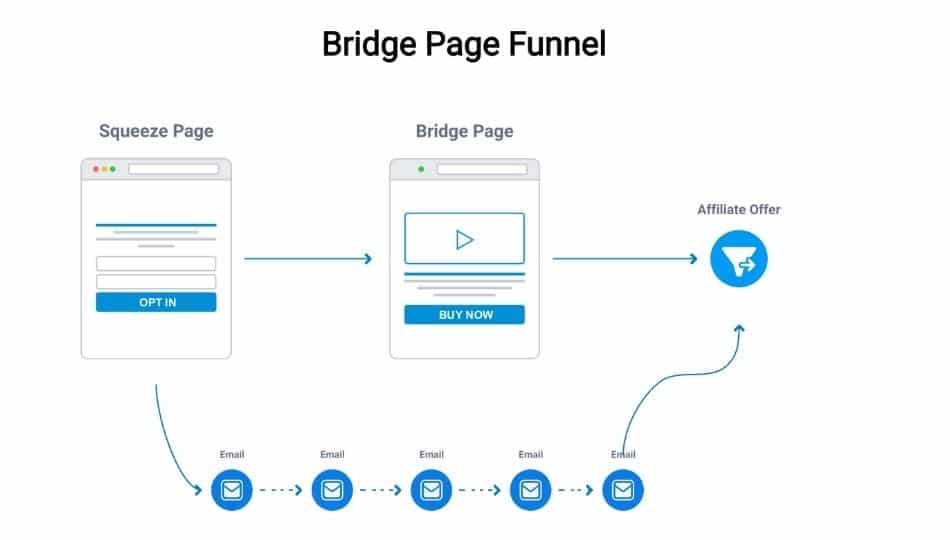
From the Bridge Page, you link out to the affiliate sales page or third-party funnel where the actual sale happens.
Why use a bridge funnel?
You want to own the traffic. Once you capture that email on the squeeze page, you can retarget, follow up, and communicate on your terms. With ad costs climbing every year, owning your leads is the only way to stay profitable.
The bridge page gives you the ability to presell the visitor before sending them into a funnel you don’t control. Without it, a cold visitor lands on someone else’s sales page with zero context and zero trust. With it, they arrive pre-framed and ready to buy.
Example: You promote an online dog training course as an affiliate. Your squeeze page hooks them with “the 3-minute exercise that stopped my dog from pulling on the leash.” They opt in. On the bridge page, you record a video showing how your dog used to drag you down the street, the method you found that fixed it in a week, and how that method comes from a specific trainer’s program. You link from the bridge page to the course sales page. You bridged the concept of leash pulling and structured dog training, and the sale happens in the next funnel.
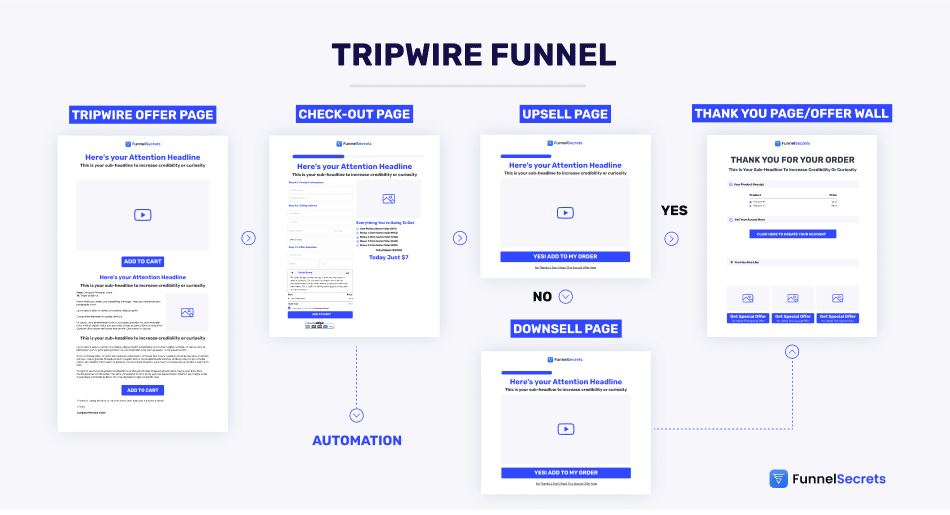
6. Tripwire Funnel
A tripwire funnel offers a low-priced product ($1–$27) to convert a lead into a BUYER. The goal isn’t to profit on the front end. The goal is to get a credit card on file so you can sell higher-priced products later.
A Tripwire funnel has 4 Steps:
- Low-Price Offer Landing Page: This page presents the tripwire product (a cheat sheet, a mini-course, or a toolkit) at a low price but high value. So your potential customers feel like a no-brainer ($7, $9, $17).
- Order Form (2-step): The form collects contact info first (name, email), then payment info on the second step. Splitting this into two steps increases completion rates because the visitor commits psychologically before pulling out their card.
- Upsell Page: Immediately after purchase, the buyer sees a one-time offer for a higher-priced product (e.g., the full course for $197). The buyer’s card is already on file, so the upgrade is a single click.
- Thank You Page: Confirms the order, delivers the tripwire product, and provides instructions for what happens next.
What’s the point of selling something for $7?
A person who spends $7 with you is 10x more likely to buy your $97 product later than someone who never spent a dime. Buyers buy. Non-buyers don’t. That $7 transaction changes the relationship from “subscriber” to “customer.”
Use it when you want to build a BUYER list (not just an email list), or when you want to offset ad costs.
An online course creator offers a “$7 Marketing Cheat Sheet” after someone opts in. After purchase, they get an upsell to the full $197 course. Even if only 10% take the upsell, the $7 sales cover the ad spend.
This funnel pairs with the Lead Magnet Funnel (#3). Collect the email with a freebie, then sell the tripwire on the thank you page.
7. Video Sales Letter (VSL) Funnel
A Video Sales Letter funnel uses video as the primary selling mechanism instead of written copy. The video follows a proven sales script: problem -> agitation -> solution -> offer → close.
A VSL funnel has 4 Steps:
- VSL Page (video + buy button): The page features a single video that walks the viewer through the sales argument. The buy button often appears partway through the video (around the 10-minute mark) to keep viewers engaged with the content before revealing the price.
- Order Form: A straightforward checkout page where the buyer enters payment details and completes the purchase.
- Upsell Page: After checkout, the buyer sees a one-click upsell for a related, higher-priced product or service.
- Thank You Page: Confirms the purchase and delivers access to the product.

Why video instead of text?
People retain 95% of a message in video vs. 10% in text (Insivia). Video builds trust faster because prospects hear your voice and see your face.
Use a Video Sales Letter funnel for mid-to-high ticket offers ($97–$997), products that need explanation, or when the founder is strong on camera.
8. Sales Letter Funnel
A sales letter funnel is the OG of direct response marketing. Long-form sales page. Storytelling. Objection handling. Testimonials. Strong close. All text.
A Sales Letter funnel has 4 Steps:
- Long-Form Sales Page: A long-form sales letter walks the reader through the entire sales argument step-by-step: problem, agitation, solution, proof, offer, guarantee, and close.
- Order Form: A checkout page where the buyer enters payment details.
- Upsell Page: A post-purchase offer for a complementary product or an upgraded version.
- Thank You Page: Confirms the purchase and provides access or delivery details.

The sales letter funnel structures and works like the Video Sales Letter (VSL) funnel. The key difference is that the sales pitch uses written words rather than video.
It fits with sellers uncomfortable on camera.
Use it for digital products, courses, and coaching programs with a strong transformation story.
Dan Kennedy is famous for his classic sales letters. His approach to sales letter funnels has generated millions over the years. While video now dominates attention, sales letter funnels remain effective for audiences who prefer detailed, text-based content.
9. Product Launch Funnel
A product launch funnel builds anticipation over multiple days before opening the cart. Instead of a single sales page, you release a series of pre-launch videos that educate, build desire, and create urgency.
A Product Launch funnel has 4 Steps:
- Product Launch Page 1 (The Opportunity): A video that shows the market opportunity and why NOW is the time. It positions the problem and hints at the solution without revealing the product yet.
- Product Launch Page 2 (The Transformation): A video featuring case studies, success stories, and transformation examples. Viewers see proof that the method works for real people.
- Product Launch Page 3 (The Method): A video that gives a taste of the actual method or framework. Viewers get enough to understand the approach — but not enough to do it alone.
- Product Launch Order Form (with order bump option): The cart opens. Buyers can purchase the main offer and add an order bump (a low-cost add-on) at checkout.
Each page connects to the next. By the time the order form goes live, people are already sold.
Use it when launching a new course, coaching program, or membership site. It works best when you have an existing audience to drive through the sequence.
Jeff Walker’s “Product Launch Formula” is the origin of this model, responsible for over $1 billion in product launches across hundreds of niches. The model works because it mirrors how Hollywood builds anticipation: trailer -> behind-the-scenes -> premiere.
This funnel takes more effort than a simple sales page. But a single launch can generate a year’s worth of revenue in one week.
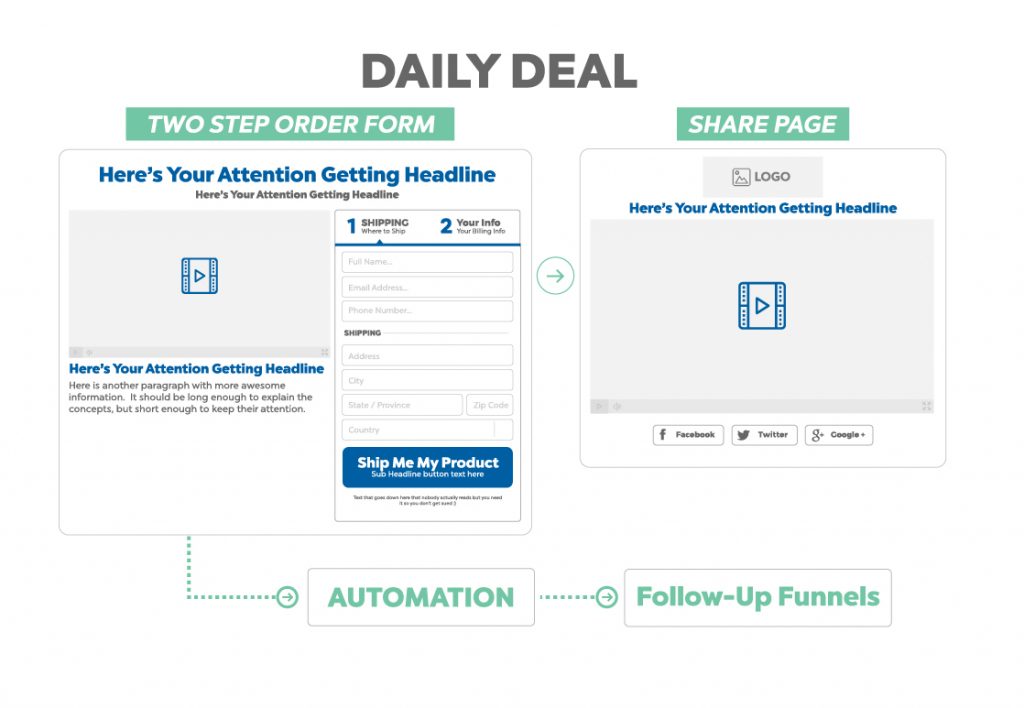
10. Daily Deal Funnel
A daily deal funnel centers on a single, time-limited offer. One product. One deal. One deadline. Think Groupon, but for your own store.
A Daily Deal funnel has 3 Steps:
- Deal Page (product + countdown timer + price): A single page showcasing one product at a discounted price with a visible countdown timer. The entire page focuses on this one offer (no distractions, no sidebar, no other products)
- Order Form: A fast checkout page designed to reduce friction. The buyer enters payment details and completes the purchase before the timer runs out.
- Thank You Page: Confirms the purchase and delivers the product or provides fulfillment details.
Use it when you’re clearing inventory, promoting a flash sale, or creating urgency for a specific product. E-commerce and physical product businesses see the best results here.
The psychology is simple: Scarcity plus urgency. The countdown timer creates FOMO. When people know the deal expires tonight, they act faster. Hesitation drops. Cart abandonment drops. Conversions rise.
Example: An online store runs a “Deal of the Day” page: 20% off a best-selling supplement, 24-hour countdown timer. They email their list and run ads to that one page. Short. Simple. Profitable.
Get this: Groupon built a $17.8 billion company on this exact funnel model. You don’t need to be Groupon. But the principle works at any scale. One product. One page. One deadline. Let urgency do the selling.
11. Deadline Funnel
A deadline funnel uses a personalized deadline for each individual visitor. Unlike a daily deal (same deadline for everyone), a deadline funnel starts the clock when THAT specific person enters the funnel.
What’s the difference between a deadline funnel and a daily deal?
With a daily deal, everyone sees “Sale ends tonight at midnight.” With a deadline funnel, every subscriber gets their own unique countdown. Someone who joins your list on March 1st gets a 5-day email sequence. Their pricing expires on March 6th. Someone who joins on March 15th gets the same sequence, but their deadline is March 20th.
A Deadline funnel has 4 Steps:
- Opt-in/Entry Point: The visitor enters the funnel through an opt-in page, a purchase, or another trigger. The moment they enter, their personal countdown starts.
- Content/Sales Sequence: A series of emails or pages that deliver value and build the case for the offer over a set number of days.
- Offer Page with Personalized Countdown: The sales page displays a countdown timer unique to THAT visitor. The timer syncs across email, the sales page, and any other touchpoint.
- Cart Closes (for that individual): When the deadline passes, the offer page changes or disappears for that specific person. No fake timers. The offer actually goes away.
You can run this funnel on autopilot, 365 days a year. ClickFunnels allows you to create personalized deadlines, helping marketers boost conversions by adding urgency tailored to each visitor.
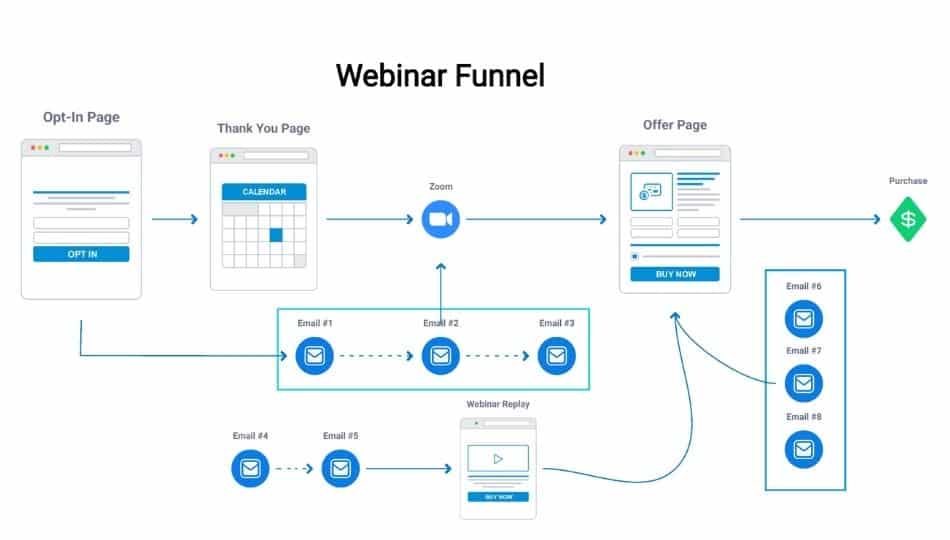
12. Webinar Funnel
A webinar funnel gets people registered for a live webinar, drives attendance, and sells at the end. The webinar is a live presentation (usually 60–90 minutes) that teaches something valuable and closes with a pitch.
A typical Webinar funnel has 5 Steps:
- Registration Page: A page where visitors sign up for the webinar. It includes the webinar title, date/time, and a brief description of what attendees will learn.
- Thank You/Confirmation Page: Confirms registration, provides calendar links, and sets expectations for the event. Some marketers add a short video here to boost show-up rates.
- Webinar (Live): The live presentation usually has 45-60 minutes of teaching followed by 15–30 minutes of pitching the paid offer. The audience watches in real-time and can ask questions.
- Offer/Replay Page: After the live event ends, this page hosts the replay video alongside the offer details, a countdown for any bonuses, and a buy button.
- Order Form: The checkout page where attendees purchase the product or program pitched during the webinar.
Why do webinars convert so well?
Fast fact: the average webinar attendee watches for 57 minutes (GoToWebinar).
You get 60–90 minutes of someone’s undivided attention.
That’s MASSIVE. In that window, you build trust, teach, handle objections, and present an offer. It’s a full sales presentation disguised as free training.
Use it for selling courses, coaching programs, software, or high-ticket services ($297–$2,000+).
Pro Tip: Do you want to create a webinar presentation that sells? Get the Perfect Webinar Secrets for just $7 to reveal the secret Russell Brunson used to sell over $3M in revenue in 90 minutes.
But what happens after you’ve run the same webinar 10 times? You automate it. That’s #13.
13. Auto-Webinar Funnel
An Auto-Webinar funnel (or Evergreen Webinar funnel) is a pre-recorded webinar that runs on autopilot, simulating a live experience. Same registration flow as a live webinar, but the content replays automatically.
An Auto-Webinar funnel has 5 Steps:
- Registration Page: Visitors pick a date and time to watch the webinar. Multiple time slots create the feeling of a scheduled event.
- Confirmed Page (date, time, calendar add): Confirms the selected time and provides calendar links. Reinforces commitment to show up.
- Indoctrination Pages (pre-webinar videos): One or more short videos sent between registration and the webinar date. These build excitement, establish authority, and increase show-up rates.
- Broadcast Page (recorded webinar + countdown): The pre-recorded webinar plays at the selected time. A countdown timer or chat simulation can replicate the live feel.
- Replay Page (video + “Add to Cart” button): After the broadcast window closes, this page hosts the replay alongside the offer and a buy button.
You record your best webinar once, and it plays on repeat. The indoctrination pages between registration and broadcast warm up registrants and boost show-up rates.
Use it when you’ve proven your webinar converts live, and you want to scale, or when you want to sell across different time zones.
Pro tip: always test your webinar LIVE first before automating. The indoctrination pages are what separate a high-converting auto-webinar from one that nobody shows up to.
14. Challenge Funnel
A challenge funnel runs a free multi-day challenge (usually 5, 7, or 30 days). Participants sign up and do one task each day. At the end, they get an offer to buy a paid upgrade.
A Challenge funnel has 3 Steps:
- Challenge Opt-in Page: The visitor signs up for the free challenge. The page explains what the challenge covers, how many days it runs, and what results participants can expect.
- VSL + Order Form Page (pitching a paid VIP upgrade): Immediately after opting in, the new participant sees a video sales letter offering a paid VIP upgrade (e.g., a $95 “Backstage Pass” with bonus materials, private group access, or direct coaching). The order form sits below the video.
- Thank You Page (instructions to join Facebook Group, set reminders, prepare): Whether the participant buys the VIP or not, this page delivers the challenge logistics — how to join the community group, when Day 1 starts, and what to prepare.
Why do challenges convert so well?
Participants invest time and effort over multiple days. That investment creates commitment. By Day 5, they’ve started seeing results AND built a relationship with you. The paid offer feels like the logical next step.
The one thing I love about the challenge funnel is that it shows your expertise fast. It helps you build a relationship with your audience. This funnel guides potential customers from free offers to high-ticket products on the value ladder immediately.
The One Funnel Away Challenge is a great example of a challenge funnel, offering a 30-day program designed to help participants build a thriving online business from scratch using sales funnels.
15. Invisible Funnel
The Invisible Funnel lets people consume the product BEFORE paying. After they experience it, they decide if it was worth the price.
Wait, you let people consume the product BEFORE paying?
Yes. And most people pay.
An Invisible funnel has 4 Steps:
- Registration Page: The visitor registers for a free training, workshop, or event. They enter their credit card info at registration, but they are NOT charged yet.
- Free Training/Workshop: The participant attends the event and receives a complete workshop, training session, or product experience.
- Post-Event Offer: After the event, the participant receives a message: “Was this worth $X? If yes, you’ll be charged. If no, email us, and we’ll cancel the charge.” The decision sits with the buyer.
- Thank You Page: Confirms the transaction (or the cancellation) and provides any follow-up materials or next steps.

The psychology is the reciprocity principle. Once people receive value, they feel obligated to honor the deal. It removes all risk for the buyer and signals massive confidence in your product.
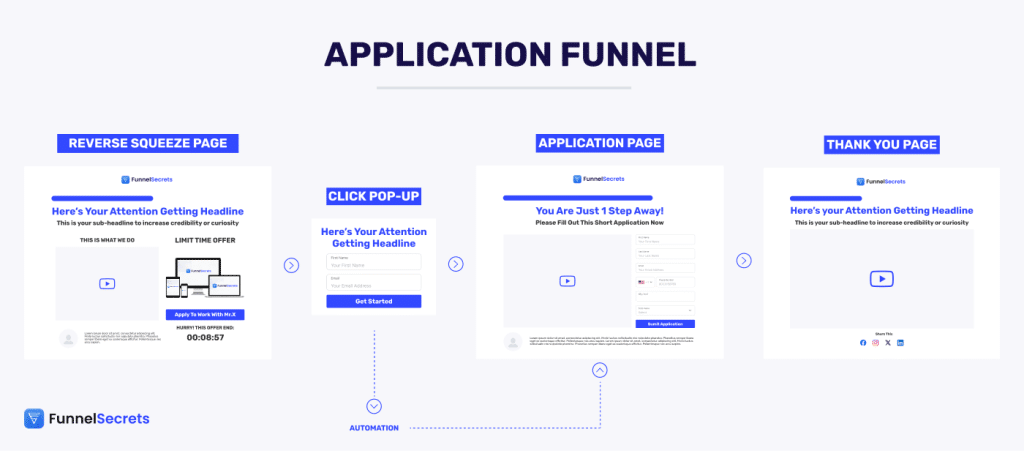
16. Application Funnel
An application funnel makes prospects APPLY to work with you. Instead of a buy button, there’s an application form. This flips the power dynamic: they’re trying to get accepted by YOU.
When you sell high-ticket programs or services like 1-on-1 coaching, SEO, content management, marketing services, real estate, or wedding photography, customers rarely buy through a checkout page. The price point and the nature of the service require a conversation. You need to shift the selling environment from online to offline. That’s what the application funnel does. It moves the prospect from your website into a phone call or meeting where the real close happens.
Think of it as the point where your sales funnel meets your sales pipeline. The funnel qualifies and filters online. The pipeline closes offline.
An Application funnel has 5 Steps:
- Sales/Info Page: A page that explains your offer, who it’s for, and who it’s NOT for. It positions the offer as exclusive and limited, making the reader self-select before applying.
- Application Form: A detailed form asking about the prospect’s business, revenue, goals, and budget. Each question pre-qualifies the lead and filters out people who aren’t a fit.
- Review/Qualification: You (or your team) review the submitted application and decide who moves forward. This step reinforces the exclusivity.
- Phone Call: Qualified applicants get on a call with you or a sales rep. The conversation focuses on fit, not selling, because the applicant already wants in.
- Close: The deal closes on the call. The applicant becomes a client.
The psychology is straightforward. When people apply, perceived value and exclusivity go up. The application also pre-qualifies leads so you only talk to serious buyers, not tire-kickers.
Use it for high-ticket offers ($3,000+), coaching programs, mastermind groups, and done-for-you services. Any offer where you want to filter out everyone who isn’t a fit.
17. Cancellation Funnel
A cancellation funnel activates when someone tries to cancel a subscription or membership. Instead of letting them leave, you present a survey asking WHY, then route them to a targeted save offer.
A Cancellation funnel has 2 Steps:
- Cancellation Page (survey): When a subscriber clicks “Cancel,” they land on a page with a short survey: “Why are you leaving?” Each answer option (too expensive, not using it enough, found a competitor, etc.) maps to a different retention page.
- Article/Offer Pages (different pages based on the customer’s answer): Each survey response routes to a unique page with a targeted retention offer. “Too expensive” leads to a discount page. “Not using it enough” leads to a quick-start guide and a free coaching call. Different reasons get different saves.
Acquiring a new customer costs 5–7x more than keeping an existing one. A cancellation funnel can save 10–20% of cancellations by showing each person the offer most likely to keep them.
Use it for SaaS products, membership sites, subscription boxes, or any recurring revenue model.
18. Live Demo Funnel
A live demo funnel showcases your product through a video demonstration and captures leads at the same time. The page combines a demo video with product listings so visitors see the product in action AND browse what’s available.
A Live Demo funnel has 4 Steps:
- Live Demo Page (demo video + “Click Here to Subscribe” button + product grid with “Buy Now” buttons): The main page features a product demonstration video. Below or beside the video, a product grid displays individual items with “Buy Now” buttons. A “Subscribe” button captures leads who aren’t ready to buy yet.
- Click Pop (pop-up opt-in form): When a visitor clicks the “Subscribe” button, a pop-up form appears asking for their email. This captures leads from visitors who watched the demo but didn’t purchase.
- Thank You Page (video + next steps): After opting in, the visitor sees a confirmation video explaining what comes next — welcome emails, upcoming deals, or product recommendations.
- Next Funnel: The lead enters your email sequence and gets routed into the appropriate sales funnel based on their interests or actions.
How is this different from a webinar?
A webinar is a scheduled event. A live demo funnel is an always-available page where visitors watch a product demo, browse products, and opt in whenever they want. More like a shoppable demo page than a presentation.
Use it for ecommerce, SaaS, or any product-based business where showing the product in action increases conversions.
A skincare brand has a Live Demo Page with the founder demonstrating a full skincare routine. Below the video, a “Subscribe” button and a product grid with individual “Buy Now” buttons. The click pop captures emails even from visitors who don’t buy immediately.
Which Sales Funnel Is Right for Your Business?
You just read about 18 types of sales funnels. If your head is spinning, that’s normal. You don’t need all 18. You need ONE to start.
| Funnel Type | Best For | Price Range | Difficulty |
|---|---|---|---|
| Squeeze Page | Building an email list fast | Free offer | Easy |
| Reverse Squeeze Page | Warming up cold traffic | Free offer | Easy |
| Lead Magnet | Generating qualified leads | Free offer | Easy |
| Survey | Segmenting audiences | Varies | Medium |
| Bridge | Affiliate marketing | Varies | Easy |
| Tripwire (2-Step) | Converting leads into buyers | $1–$27 | Medium |
| VSL | Mid-to-high ticket products | $97–$2,000+ | Medium |
| Sales Letter | Digital products, courses | $47–$2,000+ | Medium |
| Product Launch | New course/product launches | $197–$2,000+ | Hard |
| Daily Deal | Flash sales, clearing inventory | Discounted | Easy |
| Deadline | Evergreen offers with urgency | Varies | Medium |
| Webinar | Courses, coaching, high-ticket | $297–$2,000+ | Medium |
| Auto-Webinar | Scaling a proven webinar | $297–$2,000+ | Hard |
| Challenge | Community building, launches | Free + upsell | Hard |
| Invisible | High-confidence workshops | $47–$497 | Medium |
| Application | High-ticket coaching/services | $3,000+ | Medium |
| Cancellation | SaaS, memberships | Retention | Medium |
| Live Demo | Ecommerce, SaaS, products | Varies | Medium |
Knowing which funnel to build is one thing. Knowing HOW to build it step-by-step is another.
Build Your Sales Funnel Easier With Funnel Hacker’s Cookbook
You know which funnel to build now. But when you sit down to actually build it, the questions start piling up.
- Which pages go in which order?
- What elements belong on the opt-in page vs. the sales page?
- How should the order form be structured?
- Where does the upsell sit? What does the layout look like?
These gaps between knowing the funnel type and building it are where most people stall. You stare at a blank page inside your funnel builder, guess at the structure, and hope it converts.
The Funnel Hacker’s Cookbook solves this the same way a diet cookbook solves meal planning.
It gives you the recipes, ingredients, portions, and cooking steps. You follow the recipe. The meal comes out right.
The Funnel Hacker’s Cookbook works the same way for funnels. It shows you what ingredients to put in what order for each funnel type.
Most funnel in this article has a matching recipe in the Cookbook. Each recipe includes:
- The funnel type and category
- The number of pages you need
- A visual blueprint showing each page, what goes on it, and how the pages connect
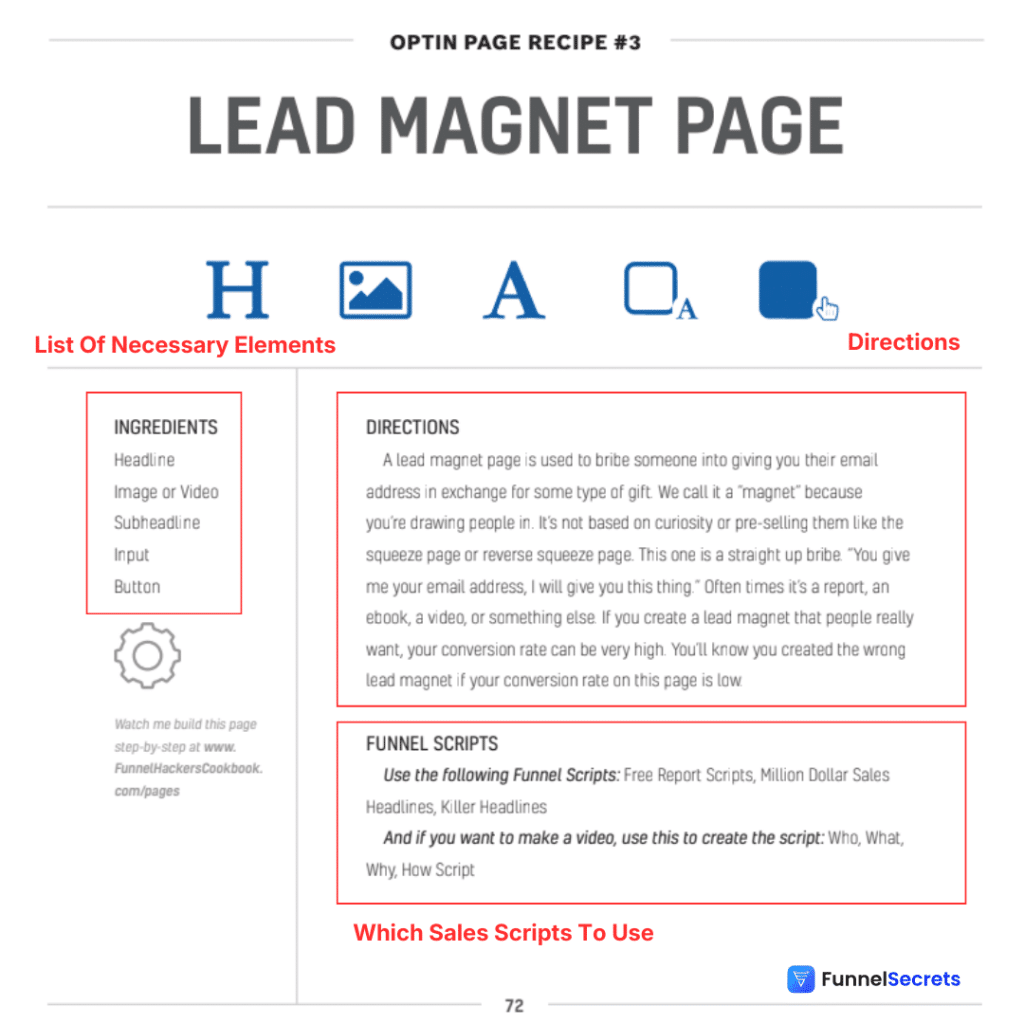
You keep the book on your desk while you build. Open to the recipe. Follow the blueprint page by page. Stop guessing.
No more wondering if you missed a step. No more putting the upsell in the wrong place. No more structural mistakes that kill conversions before you drive a single visitor.
I wrote a full breakdown of the Funnel Hacker’s Cookbook review covering what’s inside, how it’s organized, and whether it fits where you are right now.
NOTE: The Funnel Hacker’s Cookbook is made for ClickFunnels. But you can use its recipes with any sales funnel builder software you want.
Which Funnel To Build First?
You don’t need all 18. You need one.
Your business has (or should have) a value ladder: multiple offers at different price points. Free at the bottom. Low-ticket in the middle. High-ticket at the top. Each level uses a different funnel type.
A lead magnet funnel captures emails at the bottom. A tripwire or VSL funnel generates revenue in the middle. A webinar or application funnel sells your premium offer at the top.
You do NOT need to build all of these on day one.
Pick one level of your value ladder. Pick one funnel. Build it. Russell Brunson recommends in DotCom Secrets: stick with one funnel until you hit $1,000,000 in gross revenue. Then move on to the next.
That number doesn’t have to be yours. Maybe it’s $10,000. Maybe it’s $50,000. The point: pick a number, pick a funnel, and don’t get distracted building 5 funnels at once.
Pick one offer. Pick one funnel. Set your revenue goal. Hit it. THEN build the next one.