
You’ve got your lead magnet. You’ve got your offer. You’ve got your landing page builder. And now you’re staring at a blank screen, wondering which funnel type to build first.
Welcome to the club.
Funnel building sounds simple until you actually sit down to do it. There are opt-in funnels, webinar funnels, tripwire funnels, application funnels… the list goes on. And each one has different pages, sequences, and strategies. Then there’s the actual design part. If you don’t have experience with page builders or web design, laying out a high-converting page feels like trying to perform surgery with a butter knife.
That’s where The Funnel Hacker’s Cookbook comes in. It’s a recipe-style guide that promises to tell you exactly which funnel to use and when.
But does it actually simplify the process? Or is it just another info product collecting dust on your hard drive?
In this review, I’ll break down what’s inside the Cookbook, who it’s actually for, the pros and cons, and whether it’s worth your money. I’ll also share who should probably skip it.
First, let’s talk about why funnel building got so complicated in the first place.
What Makes Funnel Building Complicated?
Funnel building is complicated because it requires understanding multiple moving parts – traffic sources, page sequences, copywriting, and technical integrations – all working together.
And that’s just the strategy side.
Here’s where most entrepreneurs get stuck:
- Not knowing which funnel type fits their offer
- Zero experience with page builders (where does the headline even go?)
- Guessing what elements each page actually needs
- Wasting money on tools before understanding strategy
- Starting from scratch every single time
Then there’s the design problem. You might sketch out a beautiful funnel strategy on a whiteboard. But turning that vision into actual pages? That’s where things fall apart. If you’ve never touched a page builder before, it feels like learning a new language.
Here’s the real kicker. You could spend weeks identifying your dream customer, creating a lead magnet, and crafting an irresistible offer. But if you pick the wrong funnel type, none of it matters. And YouTube tutorials mostly cover basic lead funnels or video sales letter funnels. Those might not fit your business at all.
So entrepreneurs end up spinning their wheels, burning cash, and rebuilding the same pages over and over.
What if there were a recipe to follow instead?
This is exactly why you need the Funnel Hacker’s Cookbook, a resource designed to give entrepreneurs a clear recipe to follow.
What Is The Funnel Hacker’s Cookbook?
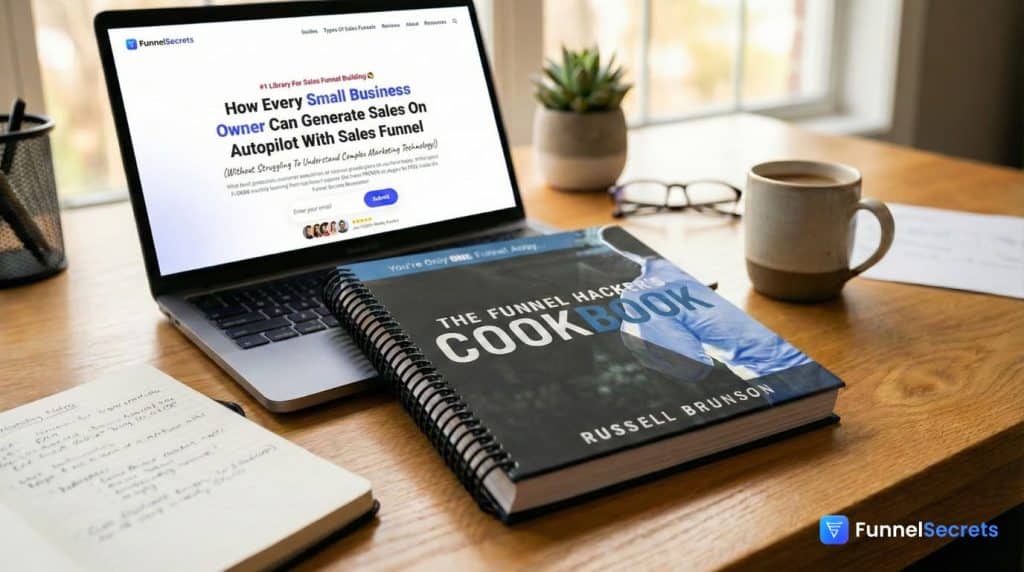
The Funnel Hacker’s Cookbook is a 255-page resource created by Russell Brunson that provides step-by-step “recipes” for building proven sales funnels. It’s designed specifically for the ClickFunnels platform, though the concepts apply to any funnel builder.
Here’s the idea behind it.
When you see an amazing cake, it almost seems like magic. How did someone make something that looks and tastes that good? But to the baker, there’s no mystery. It’s just eggs, flour, sugar, and water used in certain proportions and in a certain order.
Sales funnels work the same way.
Those funnels, which are making millions of dollars, they’re not magic. The people building them just know what elements go into each page, which pages go into each funnel, and in what order. The Funnel Hacker’s Cookbook was created to demystify the whole process and hand you the frameworks behind the most successful funnels online.
No guesswork. No staring at blank screens, wondering what goes where.
The Cookbook is available in both physical and digital formats. You can put it on your desk and flip through pages or search on your screen. Dealer’s choice.
To understand why this cookbook approach works, it helps to know who created it and what problem they were solving.
Who Created The Funnel Hacker’s Cookbook And Why?
Russell Brunson, co-founder of ClickFunnels and author of DotCom Secrets, Expert Secrets, and Traffic Secrets, created The Funnel Hacker’s Cookbook.
If you don’t know Russell, here’s the quick version. He built ClickFunnels to over $100 million in just three years. He’s a New York Times bestselling author with hundreds of thousands of books sold. And he’s got over a million entrepreneurs following his work. The guy knows funnels.
But here’s the thing.
His earlier books taught strategy and tactics. They helped hundreds of thousands of entrepreneurs understand the “why” behind successful funnels. Yet people still struggled to take action. They had the knowledge but couldn’t bridge the gap between concept and execution.
Then one day, Russell was looking at bestselling books from friends in the diet industry. He noticed a pattern. They’d write a strategy book first. Then later, they’d release a cookbook with actual recipes people could follow step-by-step.
Lightbulb moment.
Strategy without implementation is just theory. The Funnel Hacker’s Cookbook was born to bridge that gap – giving entrepreneurs the exact recipes to turn knowledge into working funnels.
Now that you know the creator’s background, let’s look inside the cookbook itself to see exactly what you get.
What’s Inside The Funnel Hacker’s Cookbook?
The Funnel Hacker’s Cookbook is organized into three main sections, each building on the previous one – much like learning to cook by first understanding ingredients.
Russell didn’t just throw a bunch of funnel templates at you. He structured the whole thing so you actually understand what you’re building and why.
Inside the cookbook, you’ll find:
- Elements (The Ingredients)
- Page Recipes
- Funnel Recipes
Here’s how they work together. Elements are the individual building blocks – headlines, videos, buttons, forms. Those elements combine to create pages. And those pages stack together to form complete funnels.
It’s a logical progression. You can’t bake a cake without knowing what eggs and flour do. Same idea here.
Let’s break down each section so you know exactly what you’re getting.
Elements (The Ingredients)
Elements are the building blocks of a funnel. These are all the things that can go on your pages. Think headlines, subheadlines, bullet points, testimonials, countdown timers, order bumps, and call-to-action buttons. The stuff that actually makes a page do something.
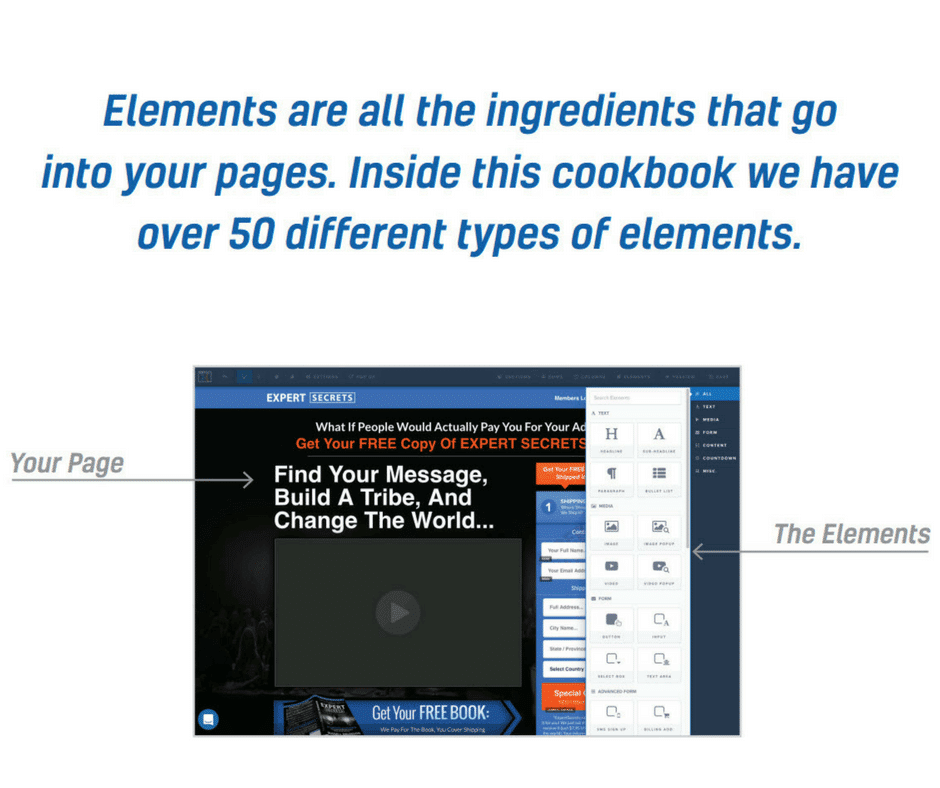
The cookbook covers over 50 different element types, all available inside ClickFunnels. They’re grouped into 8 categories:
- Text Elements
- Media Elements
- Form Elements
- Advanced Form Elements
- Countdown Elements
- Content Block Elements
- Miscellaneous Elements
- Special Elements
For each element, Russell explains what it is and shows a visual example of how it looks inside the page builder. No guessing required.
💡 Note: Not every element appears on every page type. Order form elements only show up on order form pages. Membership elements only exist inside membership pages. So if you’re hunting for something and can’t find it, you probably picked the wrong page type.
Understanding elements prevents that dreaded “blank page” syndrome. You’ll know exactly what components belong where.
But elements alone don’t make a funnel. You need to know how to arrange them into actual pages.
Page Recipes
Page recipes are step-by-step blueprints that show you exactly how to combine elements into complete, functional pages.
For example, a sales page might include a logo element, navigation bar, video element, order form, and button. Those few ingredients create a complete sales page. A squeeze page is a different “cake” – you still need a logo and headline, but you’d swap the order form for an opt-in form instead.
The Funnel Hacker’s Cookbook covers 37 page types across 10 categories:
- Presell pages: Survey page, Article page, Presell page, Clickpop page
- Opt-in pages: Squeeze Page, Reverse Squeeze Page, Lead Magnet page, Coupon page.
- Thank You pages: Thank You Page, Share Page, Offer Wall, Bridge Page
- Sales pages: Sales Letter Page, Video Sales Page, Product Launch Page
- OTO pages: Upsell & Downsell Page
- Order Forms: Sales Letter Order, Two-Step Order Page, Video Sales Letter Order Page, Traditional Order Page, Product Launch Order Page.
- Webinar pages: Webinar Registration Page, Webinar Confirmation Page, Webinar Broadcast Room, Webinar Replay Room.
- Membership pages: Access Page, Member’s Area
- Affiliate pages: Access Page, Affiliate Area
- Other pages: Home Page, Application Page, Hangout Page, Ask Page, Hero Page, Live Demo Page, Store Front
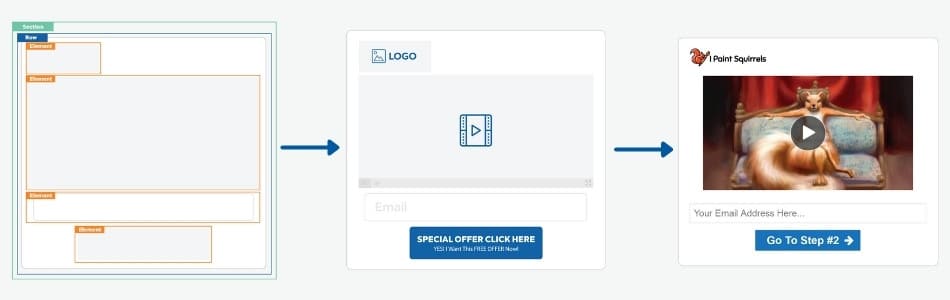
You’ll also learn page structure basics that make designing way less intimidating:
- Sections: The largest building blocks. Think of them as horizontal containers that span the full width of your page. Each section holds one big idea or area.
- Rows: Sit inside sections. Rows can be split into columns, letting you place content side by side.
- Elements: The actual stuff – headlines, images, buttons, forms. These go inside rows.
Each page recipe includes three things: ingredients needed, step-by-step directions, and which Funnel Scripts work best. For presell pages, that might mean Killer Headlines, Who What Why How Script, and Feature-Benefit-Meaning Bullets Script.
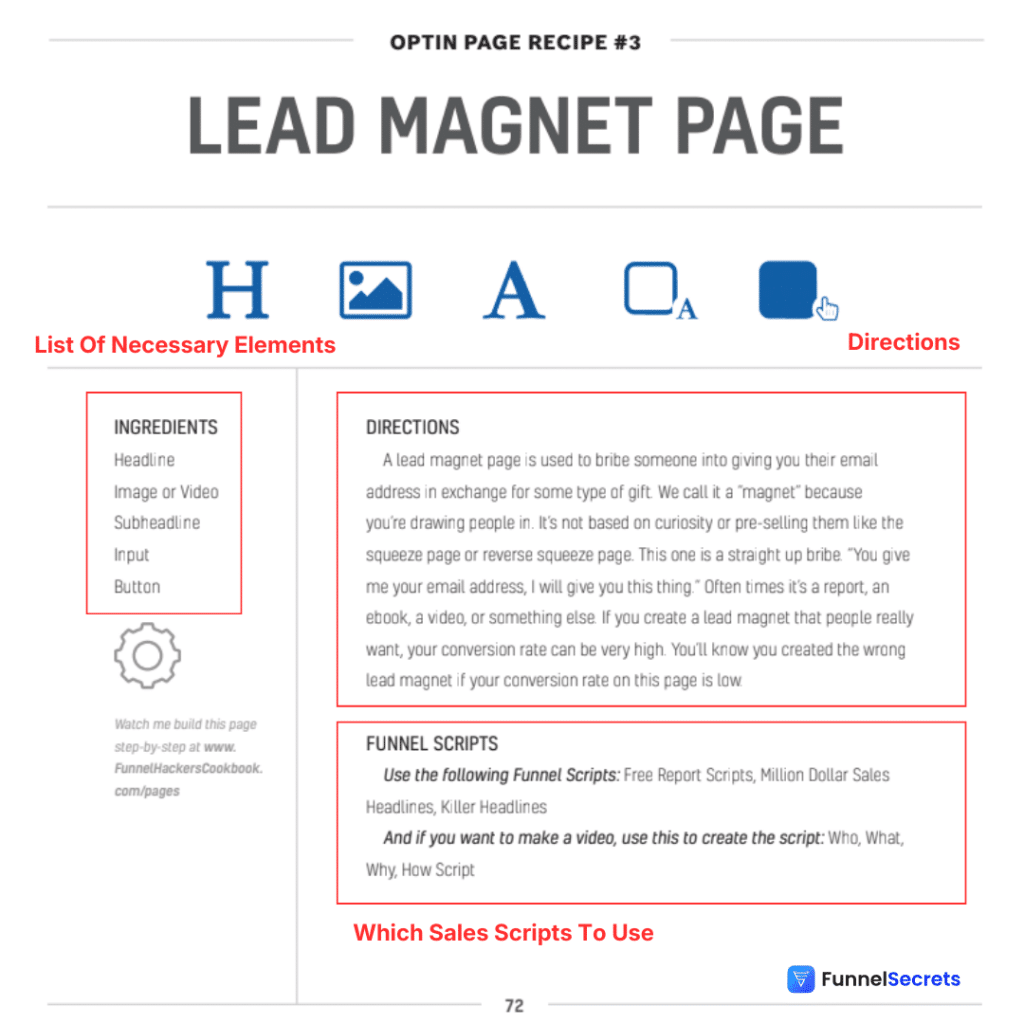
New users can grab proven templates with sections and rows already built. Just swap in your own elements. Advanced users get complete flexibility to create whatever they dream up.
Now you know how to build individual pages. But a single page doesn’t make a funnel. You need a sequence of pages working together – and that’s exactly what funnel recipes provide.
Funnel Recipes
Funnel recipes are complete blueprints that show you exactly which pages to use, in what order, to achieve a specific goal.
The cookbook provides 22 sales funnel recipes grouped into 4 categories:
- Lead Funnels: Generating leads, applications, and contact information from future customers.
- Buyer Funnels: Converting leads into paying customers through strategic offer sequences.
- Event Funnels: Filling webinars, challenges, and live events with qualified attendees.
- Other Funnels: Specialized funnels for memberships, affiliates, and unique situations.
Each recipe includes the page sequence, step-by-step directions, and guidance on how to adapt it for different business types.
Speaking of business types, Russell breaks them into six categories:
- Authors/Speakers/Coaches/Consultants (selling info products, books, masterminds).
- Professional Services (chiropractors, dentists, real estate agents)
- Retail (restaurants, gyms, salons)
- Ecommerce (physical products on Amazon, Shopify, Etsy)
- Network/Affiliate Marketing (selling other people’s products, distributors, direct sales)
- B2B (business-to-business services).
This is where the cookbook really shines. Instead of wondering “which funnel works for MY business?” you just find your category and follow the recommended recipe.
No more guessing. No more copying competitors blindly.
With all these components explained, the question becomes: Does the cookbook actually make funnel building simpler in practice?
How Does Funnel Hacker’s Cookbook Help Simplify The Funnel Building Process?
The Funnel Hacker’s Cookbook simplifies funnel building by eliminating guesswork through proven, step-by-step blueprints you can follow immediately.
Here’s how it actually works:
- No More “What Should I Build?” Moments: Instead of staring at your screen, wondering what to create, you simply select from proven recipes. Someone already tested these. Someone already failed and tweaked and optimized. You just grab what works. Your brain thanks you for not having to make fifty decisions before lunch.
- See Exactly Where Everything Goes: Every recipe includes diagrams and layouts showing exactly where each element belongs. Headlines here. Video there. Button below. No squinting at successful funnels trying to reverse-engineer their structure. No interpretation needed. Just look and build.
- Learn Once, Use Forever: Once you understand how elements combine into pages and pages combine into funnels, you’ve cracked the code. Need a new funnel next month? Same building blocks, different arrangement. It’s like learning to cook – once you understand heat and seasoning, you can make almost anything.
- Find The Right Funnel For Your Offer: The cookbook helps you identify which funnel type actually fits your offer. No more picking random templates because they looked cool. No more copying competitors who might be using the wrong funnel themselves. You match your offer to the right recipe from day one.
Let’s say you’re a fitness coach selling a $297 transformation program. You’ve got your offer nailed down. You know your audience. But you open ClickFunnels and freeze. Do you need a webinar funnel? A VSL funnel? Something else entirely?
Then there’s the design nightmare. Even if you pick the right funnel type, you don’t know where to place the testimonials. Should the video go above or below the headline? What elements does an order form page actually need?
With the cookbook, you’d flip to the Buyer Funnels section, find the Video Sales Letter Funnel recipe, and see the exact page sequence laid out. Then you’d check each page recipe for the specific elements required – hero section with headline and video, benefit bullets, testimonial blocks, guarantee badge, and order form.
No guessing. No Googling “what makes a good sales page” for 3 hours.
Of course, the Funnel Hacker’s Cookbook isn’t perfect. Let’s look at both the strengths and limitations of this approach.
What Are The Pros & Cons Of The Funnel Hacker’s Cookbook?
No resource is perfect. Here’s my honest assessment after going through the Funnel Hacker’s Cookbook.
Pros
Cons
Overall, the pros outweigh the cons for entrepreneurs who already understand funnel strategy, tactics, and copywriting. If you know WHAT you want to sell and HOW to sell it, but struggle to turn that strategy into reality inside a page builder – this cookbook delivers.
These pros and cons matter differently depending on who you are. Let’s clarify who benefits most from this cookbook.
Who Is The Funnel Hacker’s Cookbook For?
The Funnel Hacker’s Cookbook isn’t for everyone – here’s who will get the most value.
Best For:
- Solopreneurs launching their first funnels: You’ve got the offer ready but feel overwhelmed by all the options. Clear recipes tell you exactly what to build without second-guessing yourself.
- Course creators and coaches: You’re selling digital products and need different funnel types for different price points. The cookbook covers everything from free lead magnets to high-ticket applications.
- Small business owners who want proven systems: You don’t have time to experiment and fail repeatedly. Following tested recipes beats reinventing the wheel every time.
- Marketing freelancers and agencies: You’re building funnels for clients and need scalable templates. Having 22 funnel recipes on hand means faster delivery and consistent results across projects.
- Visual learners: If you learn better by seeing than reading, the diagram-based approach clicks faster than text-heavy tutorials.
Not Ideal For:
- Complete beginners to online marketing: If terms like “tripwire” and “OTO” sound like a foreign language, you’ll need basic marketing knowledge first. Start with DotCom Secrets before touching this cookbook.
- Advanced funnel builders: If you’ve already built dozens of successful funnels, you probably know most of these recipes by heart. Not much new here for veterans.
- People expecting done-for-you copy: The cookbook shows structure and elements – not what words to write. You’ll still need copywriting skills or Funnel Scripts for the actual sales copy.
If you fit the “best for” profile, the next question is how to get maximum value from your investment.
How To Maximize Your Cookbook Investment?
Owning the cookbook is just step one – here’s how to extract maximum value from it.
Most people flip through, build one funnel, and let the book collect dust. Don’t be most people.
The real power comes from understanding how to stack multiple recipes together, adapt them for your specific situation, and organize your templates for quick access later.
I’m going to share three advanced strategies that separate casual readers from serious funnel builders:
- Funnel Stacking: How to connect multiple funnels into a complete customer journey
- Recipe Modification: How to tweak recipes when your business doesn’t fit the standard mold
- Template Organization: How to build a personal library for faster builds down the road
Let’s start with Funnel Stacking.
Funnel Stacking: Connecting Multiple Cookbook Recipes
Funnel stacking means connecting multiple funnel types in sequence to guide customers through a complete journey – not just a single transaction.
Here’s what that looks like in practice.
Someone opts into your lead magnet funnel and gets a free PDF. Next, they see your tripwire funnel offering a $27 mini-course. Those who buy get invited to your webinar funnel for a $497 program. Buyers there might later see an application funnel for your $5,000 coaching.
Each funnel recipe in the cookbook works as a standalone. But when you stack them strategically, you’re not just making one sale – you’re building a value ladder that takes customers from “just discovered you” to “take my money.”
The cookbook gives you all the individual recipes. Your job is to connect them into a complete meal.
Recipe Modification Framework For Unique Businesses
Funnel Hacker’s Cookbook recipes are starting points, not rigid rules carved in stone.
Your business might not fit perfectly into any category. That’s fine. Here’s a simple framework for adapting recipes to your unique situation:
- Start with the closest matching recipe: Find the funnel type that most resembles what you need, even if it’s not perfect. A nonprofit wanting to collect donations might start with a Lead Funnel recipe and swap the opt-in for a donation form.
- Identify what to keep, modify, or remove: Maybe you need the page sequence but different elements. Or the same elements arranged differently. Make a list before touching your page builder.
- Test modifications one at a time: Change one thing, measure results, then adjust again. Changing everything at once makes it impossible to know what worked.
- Build a swipe file as you go: Screenshot funnel structures, page layouts, and element arrangements that catch your eye – both from the cookbook and from competitors. Over time, you’ll have a personal reference library of proven frameworks to pull from whenever you’re stuck.
Why follow the recipe first? Because proven sales funnel frameworks give you a baseline. You need to know the rules before breaking them. Build it by the book, then optimize based on your actual data.
Template Library Organization For Faster Future Builds
Every funnel you build is an asset. Treat it like one.
Instead of starting from scratch each time, save your completed funnels as templates inside your page builder. Future you will send a thank-you card.
Here’s how to stay organized:
- Use clear naming conventions. Something like “Lead-Funnel-Ebook-V1” beats “New Funnel 3 Final FINAL.” Include the funnel type, offer, and version number.
- Create folders by funnel category. Group your lead funnels, buyer funnels, and event funnels separately for quick retrieval.
- Note what’s tested vs. untested. Mark templates that have proven conversion data versus fresh builds you haven’t validated yet.
The magic happens over time. Your first funnel takes hours. But once you’ve built ten funnels and saved them all as templates, new projects become assembly jobs instead of construction projects. That’s how agencies pump out client funnels so fast.
Before implementing these strategies, you’re probably wondering about the investment required.
How Much Does The Funnel Hacker’s Cookbook Cost?
The Funnel Hacker’s Cookbook is free.
You can grab the digital version at no cost whatsoever. Just download and start building.
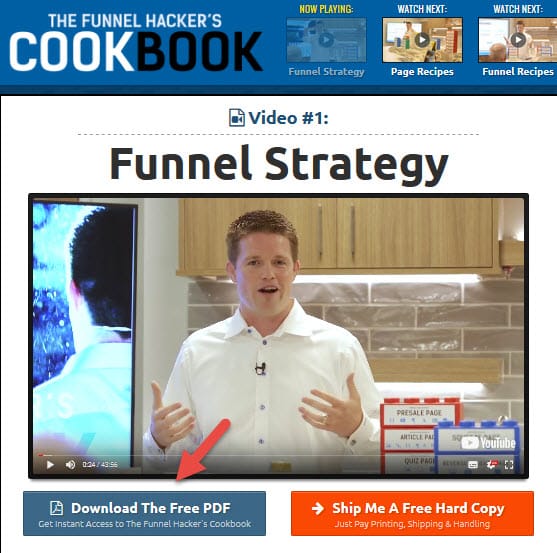
Prefer something you can flip through? The physical spiral-bound edition is also free – you just cover shipping. That’s $19.95 + tax in the US or $38.95 for international orders anywhere in the world.
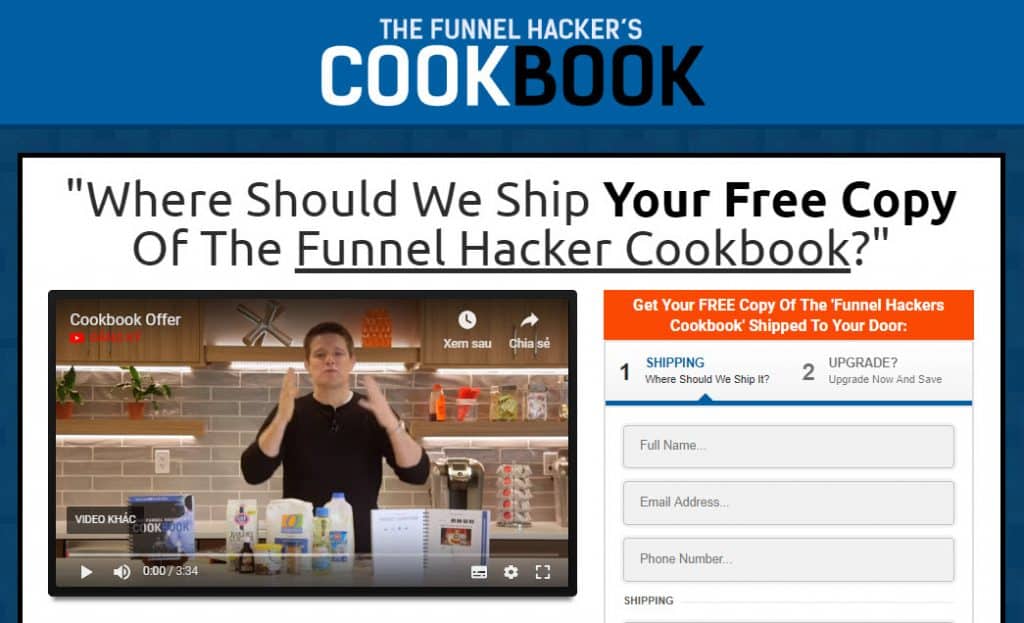
Now think about the alternatives. Hiring a funnel consultant runs $500-$5,000+ for a single build. Trial and error? That costs you months of wasted time and probably a few hundred bucks in failed ad spend.
The ROI math is simple. One successful funnel – even a basic lead funnel generating 10 leads per day – pays for that $19.95 shipping cost before your morning coffee gets cold. Everything after that is profit.
Is There A Funnel Hacker’s Cookbook Course Or Training?
Yes. When you get the book, you also receive a series of video trainings covering sales funnel strategy, funnel pages, and funnel recipes – over 3 hours of content total.
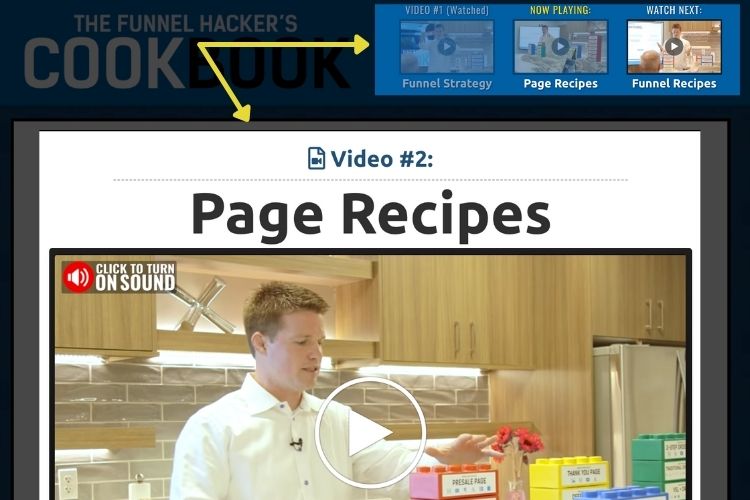
These aren’t boring PowerPoint lectures. Russell uses Lego blocks to visually demonstrate how page sequences and funnel structures work together. Watching him snap pieces together makes the concepts click way faster than reading alone.
The videos bridge the gap between understanding recipes and actually implementing them. You see the “why” behind each structure, not just the “what.”
Want to go deeper? The cookbook connects naturally with Russell’s other programs. The One Funnel Away Challenge walks you through building your first funnel in 30 days. Funnelology dives into funnel psychology. Funnel Builder Secrets bundles advanced training with ClickFunnels access.
As for ClickFunnels training resources, it depends on which version you’re using. ClickFunnels 1.0 users get access to FunnelFlix, a Netflix-style library of marketing courses.
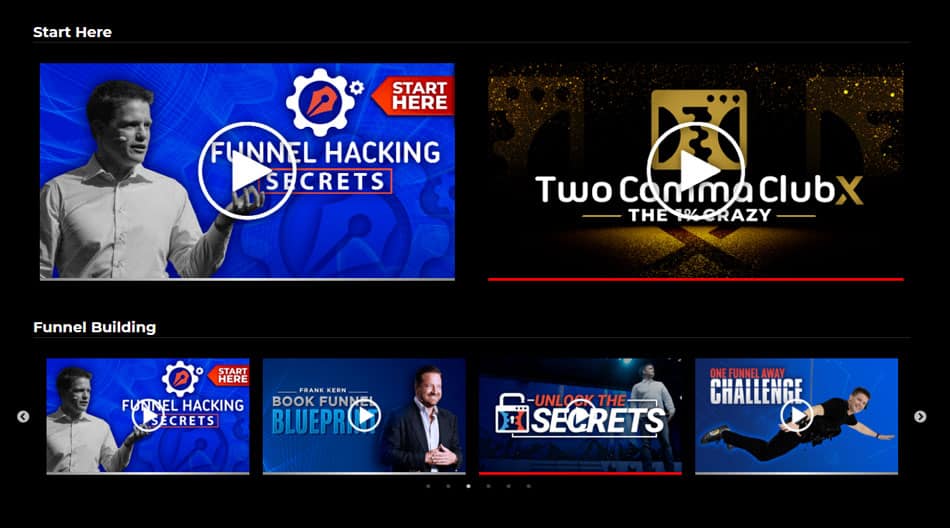
ClickFunnels 2.0 users get the Funnel Hacker Library included with the One Funnel Away Challenge.
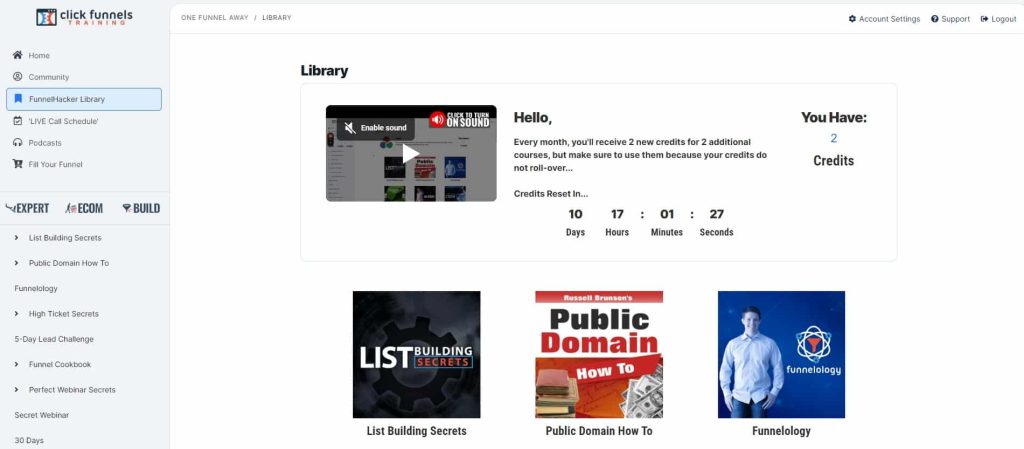
Both versions currently run simultaneously, so you’ll have training options either way.
But how does this cookbook stack up against other funnel books on the market?
How The Funnel Hacker’s Cookbook Compares To Other Sales Funnel Books?
Other sales funnel books teach strategy and tactics. The Funnel Hacker’s Cookbook teaches implementation across 22 different funnel types.
Here’s how it stacks up against the heavy hitters:
- DotCom Secrets teaches the psychology behind funnels – value ladders, soap opera sequences, and attractive characters. It’s the “why” behind what works. The Cookbook shows you exactly how to build what DotCom Secrets describes.
- The Sales Funnel Book covers funnel fundamentals and marketing principles. Great for understanding concepts, but light on actual build instructions.
- Sell Like Crazy by Sabri Suby covers traffic, conversion strategies, and teaches page construction – but only for opt-in pages and landing pages. If you need webinar funnels, application funnels, membership funnels, or any other type, that book falls short.
See the pattern? These books either stop at strategy or cover limited funnel types. The Cookbook picks up where they leave off and goes way deeper on implementation.
Funnel Hacker’s Cookbook is NOT a replacement – it’s the final piece. Read DotCom Secrets and other sales funnel books to understand the psychology, science, and art behind successful sales funnels. Then open the Funnel Hacker’s Cookbook to actually build whatever funnel your business needs.
For more recommendations, check out my top-rated sales funnel books.
So what tools do you need alongside the cookbook?
What Are Essential Tools To Use Alongside The Funnel Hacker’s Cookbook?
The cookbook shows what to build – you still need tools to build it. Here are complementary resources.
Having recipes without a kitchen doesn’t get dinner on the table. The same logic applies here.
Three tool categories will maximize your cookbook investment:
- ClickFunnels: The page builder the cookbook was designed for. Where you’ll actually construct your funnels.
- Russell Brunson’s Book Bundle: The strategy books that explain the “why” behind each recipe. DotCom Secrets, Expert Secrets, and Traffic Secrets complete the picture.
- Funnel Scripts: The copywriting software that writes your headlines, bullets, and sales copy. Because the cookbook tells you where copy goes – not what to write.
Let’s break down each one.
Clickfunnels For Sales Funnel Building
ClickFunnels and the Cookbook go together like peanut butter and jelly. Same creator. Same philosophy. Same element names and page structures.
Every screenshot in the cookbook comes from ClickFunnels. Every template mentioned exists inside the platform. When Russell says “add a two-step order form element,” you’ll find that exact element with that exact name in ClickFunnels. Zero translation required.
That seamless integration saves hours of head-scratching.
Can you use alternatives? Absolutely. Platforms like HighLevel, Systeme.io, and Leadpages can build similar funnels. You’ll get the same end result. But you’ll need to customize and figure out which elements match which names. It’s doable – just not as smooth.
Think of it like following an IKEA manual with IKEA parts versus random hardware store pieces. Both work. One’s just way less frustrating.
Want the full breakdown? Check out my review of ClickFunnels or explore alternatives to ClickFunnels if budget is a concern.
Russell Brunson’s Books Bundle For Sales Funnel Psychology and Strategies
The Cookbook shows you how to build. Russell’s Secrets Trilogy explains why it works.
Here’s the recommended reading order:
- DotCom Secrets: It teaches funnel psychology – value ladders, soap opera email sequences, and the attractive character framework. You’ll understand why certain funnels convert, and others flop. This is your foundation.
- Expert Secrets: It shows you how to position yourself as an authority and craft offers people actually want. You’ll learn storytelling frameworks, webinar structures, and how to build a mass movement around your brand.
- Traffic Secrets: It covers how to get eyeballs on your funnels – both paid and organic. Dream 100 strategy, platform-specific tactics, and filling your funnels with qualified leads.
See how they stack? Psychology first. Positioning second. Traffic third. Then the Cookbook to build it all.
Russell has written other books beyond the trilogy, too – including Network Marketing Secrets, The Linchpin, and Marketing Secrets Blackbook. Each tackles specific business models or skills.
For deeper dives, check out my complete list of Russell Brunson books.
Funnel Scripts For Sales Funnel Copies (Optional)
Funnel Scripts is a copywriting software that generates headlines, bullets, emails, and sales copy based on fill-in-the-blank wizards. Created by Jim Edwards and Russell Brunson.
Here’s the gap it fills.
The Cookbook tells you which copy elements go where – but not what words to write. Funnel Scripts handles that part.
The integration is seamless. When the Cookbook references “Killer Headlines” or “Who What Why How Script,” you’ll find those exact scripts inside the tool. Match the recipe to the script, fill in your details, and the copy gets generated.
Is it worth $797 (one-time payment)? Honestly, it’s optional.
You can use AI alternatives like Claude or Gemini instead. Claude Pro runs $200 annually or $20/month. Significantly cheaper.
But there’s a catch: You need copywriting knowledge to prompt AI effectively. Garbage prompts equal garbage copy.
Funnel Scripts removes that learning curve. The wizards ask the right questions so you don’t have to know what to ask.
Worth it? If you’re building funnels regularly and copywriting isn’t your strength, yes. If you’re building one funnel and have decent writing skills, probably not.
Read my complete review of Funnel Scripts for the full breakdown.
Funnel Hacker’s Cookbook FAQ
Still have questions? You’re not alone.
After reviewing the cookbook and talking with other funnel builders, these questions pop up repeatedly. I’ve compiled the most common ones below with straight answers – no fluff.
If you’re on the fence about grabbing the cookbook or wondering how it fits into your existing toolkit, this section should clear things up.
Let’s dig in.
Final Verdict: Should You Get The Funnel Hacker’s Cookbook?
Honestly? It depends.
Not everyone needs a cookbook to cook dinner for their family. Some people eyeball ingredients, and things turn out fine. Same with funnels – some marketers figure it out through trial and error.
But if you’ve been staring at your funnel builder, wondering what to create, the cookbook eliminates that frustration. It gives you 22 proven types of sales funnels, 37 page blueprints, and over 50 element breakdowns. No more guessing what goes where.
The Funnel Hacker’s Cookbook is worth getting if:
- You understand the funnel strategy but struggle with implementation
- You’re tired of copying competitors without knowing why their funnels work
- You want a reference guide you can use for every future funnel build
- You’d rather follow proven recipes than reinvent the wheel
It’s best for solopreneurs, course creators, coaches, and marketing freelancers who need clear blueprints – not more theory.
The value proposition is simple. For $19.95 shipping (or free for digital), you get frameworks behind millions of dollars in funnel revenue. One successful funnel pays that back instantly.
Ready to grab it? I recommend getting the physical spiral-bound version for convenience – it’s nice to flip through while building. If you’re outside the US or want to preview it first, download the free PDF version and start immediately.